Army Education Corps
Strength (30 June 1940) – 1 officer, 9 men
11 June 1940 – Malta at War
Deaths among the military 1940 (Crew F A E p 626 table 79)Diseases leading to invalidism 1940 (Crew F A E p 626 table 80).
In Apr 1940, the Governor, Lt Gen Sir Charles Bonham-Carter (Mar 1936 – Apr 1940), fell ill with pneumonia and coronary thrombosis. He returned to England on 24 May on prolonged sick leave.
Lt Gen Sir William George Sheddon Dobbie (Apr 1940–7 May 1942) arrived as Acting Governor and Commander in Chief in relief of Sir Charles Bonham Carter.
Italy declared war at midnight 10 June 1940. The first air raid warning sounded at 06:50 11 June 1940, with Hal Far being bombed at 06:55. About 30 bombs were dropped between Benghajsa and Birzebbugia. Kalafrana was also attacked. Further raids took place throughout the day. In the fog of war, three friendly motor torpedo boats from HMS St Angelo received artillery fire at 19:44, resulting in their destruction and Maltese casualties.
In the early months of the war, casualties were evacuated by sea to Alexandria. Others were taken off when the first convoy reached Malta three months after the onset of the siege.
The first hospital ship arrived early in 1941 to take the casualties of the aircraft carrier HMS Illustrious. Movement of casualties then became more irregular and averaged one to four a week. Casualties were transferred by bomber aircraft to Egypt, by flying boats to England, or by submarine to Gibraltar.
Psychiatric patients were not evacuated. Up to the close of 1942, forty one cases of TB had been evacuated. Submarines supplied Malta with drugs and medical stores.
On 2 May 1940, families were placed at 6 hrs notice to embark. On 20 May, families quartered at the Camerata and Paceville were moved to Pembroke and Tigné Barracks. 500 Naval families were billeted in St Georges Barracks. E Block St Andrews Barracks was converted into a 60 bed Reception Station to provide them with medical care.
Evacuation was not compulsory but only on a voluntary basis. On 20 May, all those military families who had chosen to return to England were embarked at Parlatorio Wharf HM Dockyard.
Infantry Brigades
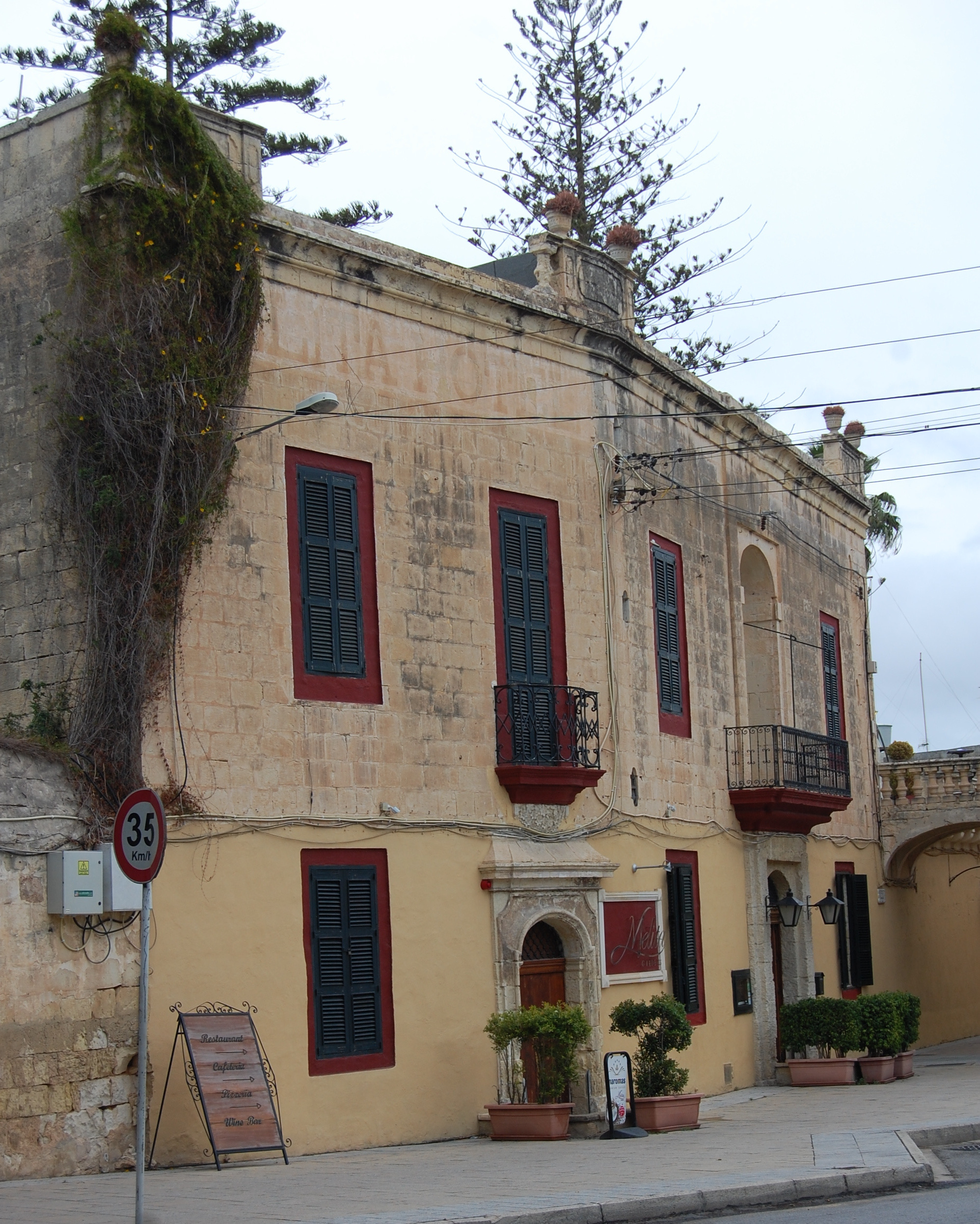
On 7 Aug 1940, the Melita Hotel Attard became HQ North Infantry Brigade.
In Nov 1939, the army strength in Malta was raised from a Brigade to a Division, under the command of Maj Gen Sir Sanford John Palairet Scobell.
On 10 June 1940, Malta was divided into the following Infantry Defence Sectors: Mellieha (1/KOMR) with sector HQ at Mellieha O.P. (GR 3333), Wardija (8/Manch) with sector HQ at Tas Saliba Rd (GR 3429), Pembroke (2/RIF) with sector HQ at San Pawl Tat Targa (GR 4128), Harbour (Fortress Reserve), St Thomas Bay (1/Dorset) with sector HQ near Hompesch Arch (GR 493226), Marsaxlokk (2/Devon and A Coy 2/KOMR) with sector HQ at Road Junction (GR 485223), and Sector 2/KOMR (G Coy 2/KOMR) located at Verdala Palace.
Bde Inf Reserves of Coy strength were held at: Iz Zebbieh (Wardija Sector), Hal Far (Marsaxlokk), Res Bn at Ta Qali, Res Bn at Luqa.
Northern Infantry Brigade was established on 7 Aug and consisted of 8/Manch, 2/RIF, 1/KOMR and 2/KOMR. It was commanded by Brig W H Oxley with its HQ at the Melita Hotel Attard.
Map of Medical units dated July 1942 by Sgt J A Critchley showing lines of evacuation (TNA:WO 222/383 DDMS Malta).
Southern Infantry Bde was made up of 2/Devon, 1/Dorset, 2/RWK and 3/KOMR. It was commanded by Brig L H Cox MC with its HQ at Lascaris Bks, but which moved to Luqa on 8 Aug 1940.
HQ Malta Infantry Bde remained at War HQ Lascaris Barracks.
Medical Aid Posts
The following medical units became operational between April and May 1940. More Advanced Dressing Stations opened at Zabbar and Zejtun after Dec 1940 when the garrison expanded to 16,000 men:
Advanced Dressing Stations
Government School Mgarr (335288)
San Pawl Tat Targa (411289)
E Block St Andrews Barracks
Rock Store Floriana
Villa Barbaro Tarxien (483221)
Villino Chapelle St Paul's Bay (376321)
Medical Aid Posts
Tigne Barracks – casevac via ADS St Andrews
R N Hospital Bighi – casevac via ADS Tarxien
RAF Sick Quarters Kalafrana – casevac via ADS Tarxien
RAF Sick Quarters Hal Far – casevac via ADS Tarxien
Mellieha (332335)
Military Hospitals
Nursing Sisters General Hospital Mtarfa Oct 1940. (TNA:WO 177/1360)
General Hospital Mtarfa was the only army hospital when Italy entered the war.The hospital was located a mere two miles from Ta' Qali aerodrome. Adjacent to it was the Barrack Hospital; both were repeatedly bombed during raids on Ta' Qali airfield. By 27 June 1940, the hospital had expanded to 1,260 beds, including 60 beds in the Family Division. On 3 July, the Isolation Block which had been used as offices, opened as an Isolation Hospital for families; the isolation wards in the Families Hospital were shut and all patients transferred to the Isolation Block.
Medical reinforcements arrived in Oct 1940, bringing 30 army sisters and as many RAMC officers. On 16 May 1940, patients from Bighi Hospital were moved to General Hospital Mtarfa, where a ward was set aside for them. Three medical officers, including a surgical specialist and an ophthalmic specialist, six to eleven nursing sisters and 29 sick berth ratings manned the naval wing. The naval medical officers from Bighi Naval Hospital were integrated with the officers of the RAMC, the majority of whom were consultants from various parts of the British Isles. A skeleton staff remained at Bighi and manned a Casualty Clearing Station. The naval hospital was severely damaged on 10 July, when the operating theatre and x-ray department were destroyed.
Two military hospitals reached Malta in 1941. No 45 General Hospital (GH) arrived in May 1941 and was ready to admit patients in July 1941. No 45 GH opened at Pembroke Garrison Gymnasium while the Sandhurst Barrack Block St Patricks was converted into a hospital, which became No 45 GH.
No 39 GH arrived in Sept 1941 and took over the huts at St Paul's Barracks from Command Convalescent Depôt. It functioned briefly from 2 Feb until 25 Apr 1942, when it was rendered non operational by enemy action.
On 3 June 1940, Military Hospital Mtarfa went on a war footing. All ranks were confined to barracks, had to carry their steel helmet, respirator and field dressings in their respirator's haversack. The hospital became operational on 18 June 1940, seven days after the Italians had declared war on the island. No further ante-natal clinics were held at Floriana, but weekly clinics commenced at St Andrew's Aid Post.
As Mtarfa Military Hospital was elevated to No 90 British General Hospital, all military personnel were given acting promotion. Medical stores were in short supply, and the only antibiotic available on the wards was sulphonamide tablets, often ruined by sea water. These were crushed, and used as a powder on wounds.
Percy Hope Falkner
Lt Col Percy Hope Falkner (Mtarfa Military Cemetery)
Lt Col Percy Hope Falkner RAMC FRCSI died at Malta on 9 Oct 1940. He was born in Bray Co Wicklow on 16 Feb 1876. He was commissioned Lieutenant on 27 July 1899 and retired on 23 Mar 1926.
In the South African War, (1899 - 1902), he took part in the Relief of Ladysmith and was present at the actions at Colenso, Spion Kop, Vaal Kranz, Operations on Tugela Heights (14 Feb 14 to 27 Feb 1900), and the actions at Pieters Hill. He also took part in operations in Natal (Mar to June 1900) and the actions at Laings Nek (6 to 9 June 1900).
He served in France and Belgium in 1914-1915. He was brought to notice for his valuable services rendered in connection with the war.
Medical Women in the Forces
Medical women volunteering for service under the Army Council were initially offered either Relative Rank with the RAMC without a commission or a commission in the Women's Forces to serve with the RAMC. The Medical Women's Federation considered that Relative Rank only was preferable and advised medical women not to accept commissions in the Women's Forces.
However in 1942, the Medical Women's Federation was informed that medical women will not in future be permitted to choose relative rank without a commission, but must be given a commission in the Women's Forces. That is, they receive a commission in the Women's Forces to serve with the RAMC, just as a medical man received a commission in the Land Forces to serve in the RAMC.
They appeared in the Army List under Women's Forces employed with the RAMC with their War Substantive rank of either Lieutenant or Captain. Alternatively, they appeared under Women's Forces employed with the Medical Branch of the Royal Air Force with the rank of Flying Officer (Temporary).
Bowden J, Grey Touched with Scarlet. (Great Britain: Ebenezer Baylis and Son, 1959), 47-105.
Henry Harris, The Royal Irish Fusiliers. (London: Leo Cooper Ltd), 121-129.
Wismayer J M, The History of the King's Own Malta Regiment. (Malta 1989).
General returns of the regimental strength of the British Army on 31 March 1940.
General returns of the regimental strength of the British Army on 30 June 1940.
General returns of the regimental strength of the British Army on 30 September 1940.
Coulter J L S, The Royal Naval Medical Services. Vol 1 Administration. London HM Stationery Office 1954.
Drew R: Commissioned Officers in the Medical Services of the British Army Vol II. Roll of Officers in the Royal Army Medical Corps 1898–1960. London The Wellcome Historical Medical Library 1968.
Official history of the Second World War. Medical Services Vol 1 1939-40 Chap 13 Malta 1940–43.
Waterman B B, Memories of Malta 1940–42 J Roy Nav Med Serv 1984;70:182–185.
Crew F A E, History of the Second World War. The Army Medical Services, Campaigns, Vol 1, Chap 13 Malta 1940–43, p 613–632. London HM Stationery Office 1956.
Status of Medical Women in the Forces Br Med J 4 July 1942; page 23.
TNA:WO 177/1083, War Diary Military Families Hospital Mtarfa April 1940 to June 1940.
TNA:WO 177/1360, War Diaries No 90 British General Hospital April 1940 to September 1946.
TNA:WO 177/104, Convalescent Depôt Malta March 1941 to November 1945.
TNA:WO 177/101. Medical Diaries DDMS Malta April 1940 to December 1943.